
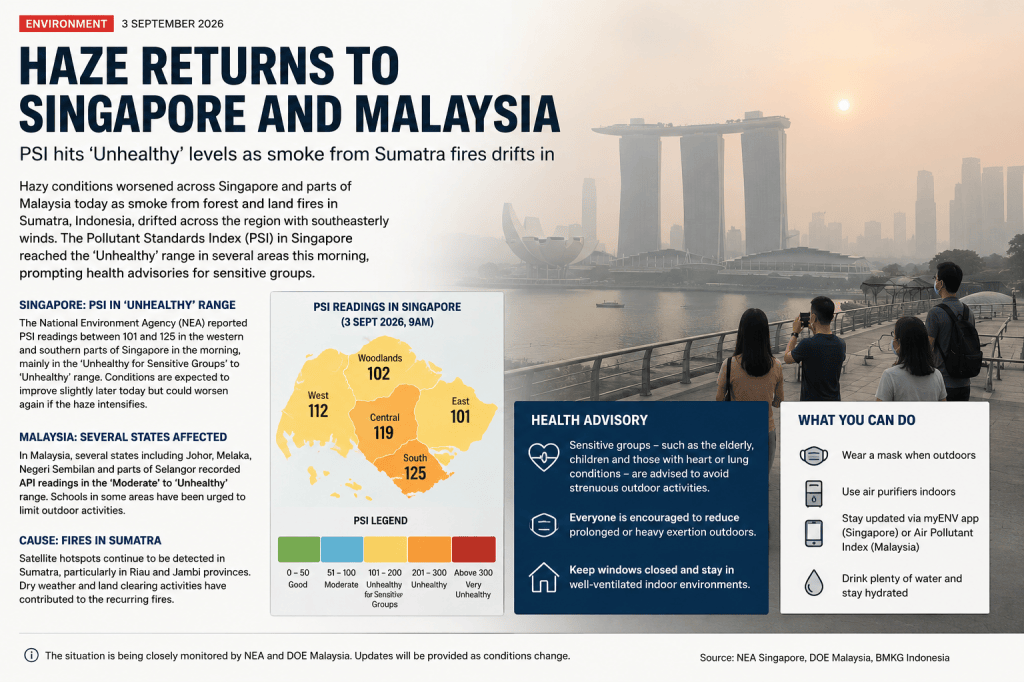
Singapore’s central region enters the unhealthy range as haze conditions worsen across parts of Malaysia
4 September 2026 | Environment
Haze has returned as a major regional concern, with air quality deteriorating in Singapore and several parts of Malaysia amid continuing dry conditions and fires in the region.
In Singapore, the 24-hour Pollutant Standards Index (PSI) in the central region crossed into the “unhealthy” range on Friday morning. The reading exceeded 100, marking the first time Singapore’s air quality had entered this range in 2026.
The deterioration comes after Singapore’s Meteorological Service warned earlier this week that dry conditions could persist into the first half of September. Regional fires, combined with prevailing winds, could bring more smoke and haze towards Singapore if fire activity intensifies.
Singapore: PSI crosses the unhealthy threshold
Singapore’s air-quality scale classifies a 24-hour PSI reading of 101 to 200 as “Unhealthy”, while readings above 200 are considered “Very Unhealthy”.
The central region recorded a PSI of 101 at around 7am, with the reading subsequently rising to 104 at 9am, according to reports citing National Environment Agency monitoring data.
The development has prompted increased attention from schools, businesses and the public, particularly for people who may be more sensitive to poor air quality.
Singapore authorities have also stressed that the situation is being closely monitored, with haze advisories and response measures available should conditions deteriorate further.
Malaysia sees more severe conditions
Malaysia is experiencing a more widespread impact, particularly in Sarawak, where several locations have recorded very unhealthy or hazardous air quality.
As of Friday morning, Serian in Sarawak recorded an API reading of 495, placing it in the hazardous category. Kuching recorded 289, while Samarahan and Sri Aman also recorded very unhealthy readings.
The situation follows several days of worsening air quality across Malaysia. Earlier reports showed unhealthy conditions affecting locations in Sarawak, Sabah, Peninsular Malaysia and Labuan.
Authorities have increased monitoring and enforcement efforts as dry conditions and open burning contribute to deteriorating air quality.
Regional fires remain a major concern
The latest haze episode is linked to a broader regional pattern of forest and land fires. Satellite monitoring has detected significant fire activity in parts of Sumatra and Kalimantan, with smoke potentially being transported across national borders by prevailing winds.
Air-quality monitoring earlier this week showed particularly poor conditions in western Sarawak and parts of Peninsular Malaysia, while areas of Indonesia were also affected by severe pollution.
The return of haze highlights the continuing regional challenge of managing forest and peatland fires during prolonged dry periods.
What happens next?
Weather conditions will be an important factor in determining whether the haze improves or worsens.
Singapore’s Meteorological Service has warned that hazy conditions could occur if fires in Sumatra and Kalimantan intensify and winds continue to transport smoke towards Singapore. Some rainfall is expected, but the broader dry conditions mean the regional fire risk remains a concern.
For now, authorities in Singapore and Malaysia are continuing to monitor air-quality readings and regional fire activity closely.
Residents are advised to check official air-quality readings regularly and reduce prolonged or strenuous outdoor activities when air quality deteriorates, particularly when readings enter unhealthy ranges.
The bigger picture
The latest haze episode is a reminder that air pollution in Southeast Asia does not respect national borders. Fires in one country can affect the air quality, visibility and daily lives of people across neighbouring countries.
With September typically presenting heightened fire risks under dry conditions, Singapore and Malaysia will be watching regional weather patterns and fire activity closely in the days ahead.
 The Mamak Corner
Leave a comment